Tuesday, January 25, 2011

Review: Double Falsehood (Union Theatre)


 Double Falsehood has a very chequered history: this curiosity has been hanging around in the Shakespearean apocrypha since its ‘discovery’ in 1728 by the Shakespeare editor and theatre impresario Lewis Theobald. He claimed that it was by Shakespeare and John Fletcher, with whom he collaborated on Henry VIII and Two Noble Kinsmen. Any credibility was lost when Theobald became a bit of a joke, after he was satirised by the acidic quill of Alexander Pope in The Dunciad (I’m feeling the need to stick up for poor Theobald and wonder if Pope was a little jealous). This outcast child was controversially legitimised in 2010 when the Arden Complete Works of Shakespeare published a fully annotated version of Theobald’s text, the version presented in this production, giving academics and regular theatregoers the chance to get a taste of what all the commotion was about.

What can be ascertained from an exercise like this is whether the play is any good dramatically. It’s neatly plotted (apart from some of the to-ing and fro-ing in the monastery where it gets a bit muddled) and tightly paced without any superfluous subplots. Phil Wilmott’s production is elegantly minimalist with its vaguely 1950s Mediterranean setting and lucid approach. The simplicity offers a freshness unburdened by intrusive gimmicks, encouraging the audience to pay attention to what’s on show, rather than fixating on the convoluted background.

In terms of content, this has all the ingredients of Shakespeare pastiche: star-crossed lovers, cross-dressing, a resentful younger brother, parents and children who are separated and reunited, and a miraculously contrived and bittersweet reunion scene. There isn’t much in the way of comic relief, but I can’t say I really missed that. Most of the characters aren’t particularly complex and the fairly workmanlike language only has a few striking turns of phrase, offering a sense of a play written by someone who is just getting to grips with the tricks of the trade – and perhaps trying a little too hard to get all the recognisable tropes in.

Gabriel Vick and Emily Plumtree speak the verse beautifully and have an affecting chemistry as the central lovers Julio and Leonora (an appealingly determined and outspoken young woman), who are separated by Leonora’s deeply unsympathetic mother (Su Douglas). She is forced to marry the bullying, snivelling Henrique, rapist of the servant girl Violante, before all can be resolved. Unfortunately, Adam Redmore’s Henrique is the evening’s weakest link, never seeming comfortable with his character or the language.

The unfortunate Violante (Jessie Lilley) is a breath of fresh air, a spurned woman who is more practical than desperate. She comes from the same tradition as the masochistic Helena who is happy to degrade herself for the sake of the moronic Bertram in All’s Well That Ends Well, and Mariana in Measure For Measure, who still loves Angelo after he abandons her. These are women who go to extreme measures to ensnare their men, but Violante doesn’t resort to trickery or grovelling and is clear-eyed about only being determined to marry her rapist in order to protect herself from disgrace (anyone who has sex in these plays automatically gets pregnant). I’d like to unearth a sequel (Double Falsehood: Take Two, perhaps) in which she murders him on their wedding night.

According to the gentleman sitting next to me, the official Shakespeare/Fletcher collaboration about thwarted lovers, The Two Noble Kinsman, is a real bore. Double Falsehood might not be a literary masterpiece, but it definitely isn’t boring. My totally amateur guess would be that it was based on a fragment of an anonymous Jacobean work, heavily embellished by Lewis Theobald. Whoever the author(s) were, they knew what they were doing.

Written for A Younger Theatre

Friday, December 24, 2010

Review: The Nutcracker (Pentameters Theatre)


 There are few things more quintessentially Christmassy than Tchaikovsky’s The Nutcracker, based on the German writer E.T.A. Hoffmann’s frankly really weird sounding 1816 novella The Nutcracker and the Mouse King. The ballet’s fame has long eclipsed its source material’s and this quirky interpretation presented by young company Butterfly Wheels led by Alice Old and Kayleigh Allenby (who have written and directed the show) has returned to the original story and given it a contemporary flair. There’s no Land of Sweets in Hoffmann and the gracious Sugar Plum Fairy and her friends are replaced by the young heroine Marie’s creepy clown dolls who descend from their shelf and dance- truly the stuff of nightmares.

It’s always fun to explore a ‘new’ theatre for the first time and the Pentameters is a lovely and very friendly above pub affair about a minute away from the Hampstead tube station with velvet scatter cushions on the seats (like a Hampstead Rosemary Branch). Entering the auditorium is like walking into a secret grotto and chocolate is very kindly given out. The set (designed by Alice Old and Amelia Marchant) has a really exuberant home-made quality, offering an exaggerated version of a perfectly traditional Christmas scene.

It’s undeniable that this ‘multi-sensory’ company throws just about everything except the kitchen sink into the production, reflecting the cast’s very varied backgrounds. Early nineteenth century Romanticism meets the New Romantics of the 1980s and it combines story telling, music and dance of all different kinds, video and shadow puppetry. A haunted mechanical remix of the Sugar Plum Fairy’s suite creepily illuminates the nature of Marie’s eccentric godfather Drosselmeir’s clockwork works of art (not toys) and the violin playing is beautiful- it’s a pity that more of the music isn’t played live

Much of the show is pre-recorded (the sound is bit of a problem- the Mouse King’s rap is incomprehensible), which adds a layer of distance between the characters and audience and there’s an emphasis on developing the atmosphere at the expense of narrative and character. The shadow puppet re-telling of how the Nutcracker came into being (Katie Mitchell uses a similar device in her production of Beauty and the Beast) offers the kind of story that you can get immersed in, in contrast to the rather stilted writing that peppers the main narrative.

This love child of Tim Burton, Kate Bush and Sarah Brightman is definitely an avant-garde alternative to the usual festive fare. Butterfly Wheels clearly have a lot to offer and have created an excellent, striking aesthetic, but the dramatic qualities need quite a bit of fine tuning to really make the piece flow and feel complete. I can’t say that it’s the most lovable Christmas show around and it’s hard to pitch exactly what kind of audience it’s aimed at. It’s too scary and conceptual for very small children but the moody quality may well appeal to teenagers. An Amazon voucher has just turned up in my inbox and a copy of the original Hoffmann seems an excellent way of spending it.

Written for A Younger Theatre

Tuesday, December 21, 2010

Review: Salad Days (Riverside Studios)

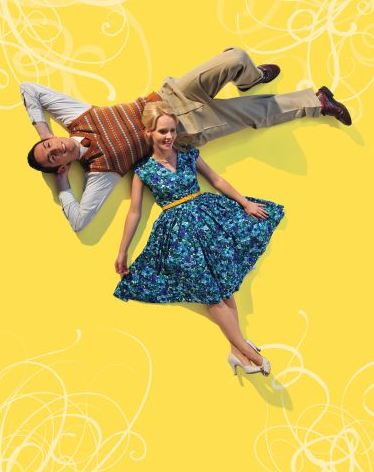
In some ways, it’s quite difficult to believe that Julian Slade and Dorothy Reynolds’s musical Salad Days is set in the present day of 1954 as there’s something about the perpetual sunshine that feels so Edwardian. The balmy summer in which our protagonists learn how to dance and fall in love is enchantingly brought to life in this revival of a production originally presented by contemporary opera company Tête à Tête and directed by Bill Bankes-Jones last autumn.

It’s no wonder that Salad Days was the longest running musical in grim and grey post war Britain (prior to My Fair Lady) with its abundance of charm and sunbeams, combined with utterly glorious music, erudite lyrics and skilfully bonkers yet emotionally truthful book. 

This is the silliest of silly musicals and the real magic comes from the way in which it is so cleverly done that the audience is more than happy to be swept away in a sea (or even a saucer) of whimsy. By the end, the songs and characters all feel like old friends.

 Bright young things Timothy and Jane are graduating from the idyllic bubble of university after three years of avoiding lectures and enjoying picnics on the quad and finding the real world rather more difficult to navigate. Jane’s mother wants her safely married off to an eligible young man (preferably a Lord) and Timothy finds himself with a degree but no qualifications to do anything useful (that’s certainly still resonant today) without the help of his assorted high-flying uncles. While mulling over their options, the pair are unexpectedly given the guardianship of a magical piano named Minnie who makes everyone who hears her want to dance, be it Charleston, foxtrot or tango (showcased by Quinny Sacks’s sprightly choreography). And why on earth wouldn’t they?

In many ways, this is the 1950s successor to Gilbert and Sullivan, but it very much has its own character and it’s a true delight to hear such clear unamplified voices fill the air. While a small concert hall isn’t really the ideal space for what’s essentially a chamber piece and some of the transitions between scenes are a little muddy, it is prevented from feeling cavernous by the traverse staging and the non-threatening audience-cast involvement. The cast dressed as university dons escort the audience to their seats and at the height of the celebrations, members of the front row are invited to dance. Despite usually being audience participation phobic, I rather envied the ones who were chosen.

Earnest young Timothy is charmingly portrayed by Sam Harrison as a thoroughly decent sort with lots of wide-eyed charm. He is beautifully matched by professional theatre debutante Katie Moore who makes an enchanting ingénue as Jane, with that particular kind of English Rose vocal purity reminiscent of Julie Andrews and lots of brisk common sense. The entire cast are on tip-top form, including Les Miserables’s original Cosette Rebecca Caine as Jane’s glamorous and glacial mother (a pity she doesn’t have more to sing) and Tony Timberlake as the twinkle-toed police inspector.

This is feel good theatre at its purest and a period piece that fully embraces the sweetness rather than trying to put an ironic spin on it. A real heartwarmer that sends one wanting to Charleston out into the snow.

Written for musicOMH

Sunday, December 19, 2010

Review: Once Bitten (Orange Tree Theatre)


For the festive season at the delightful Orange Tree Theatre, Artistic Director Sam Walters offers a kind of grown up pantomime in the form of a totally lightweight French farce. I don’t think any kind of theatre makes me as nervous as, in my experience, farces tend to be either glorious or unbearable. Reggie Oliver’s translation of Alfred Hannequin and Alfred Delacour’s 1875 farce (a prototype in the genre) Once Bitten offers something in the middle: apart from some elements of snobbery that mark it out as very much of its time, the piece has its heart in the right place and the Belle Epoque costumes are delectable, but the writing isn’t consistently funny or frantic enough to sustain nearly two and a half hours.

As Reggie Oliver explains in the programme notes, farce developed in early nineteenth-century France as light entertainment for the emerging bourgeoisie who wanted to see elements from their own society on stage. I wonder if the new middle classes really were as rich and idle as the people who inhabit these plays and the attitude towards servants almost makes one wonder if the Revolution actually happened. I may be reading into something that isn’t there, but it did leave (to this reviewer at least) an aftertaste of smugness and snobbery.

The would-be lawyer Fauvinard is planning a rendezvous with his mistress Cesarine using his friend Tardivaut (a debonair Mark Frost) as his alibi, but nothing goes according to plan, especially when his interfering mother-in-law (played by Briony McRoberts with echoes of Endora from Bewitched) gets involved. An evil poodle also wreaks havoc and several hands have to be bandaged along with wounded dignities and egos.

David Antrobus’s high energy performance gives Fauvinard an appealing sense of an essentially decent man motivated more by a desire to escape from the home that his mother-in-law dominates than by lust (a pity that his wife Angele is such a nonentity). Michael Kirk has a small but rambunctious cameo as an officious Commissioner of Police and I liked Rebecca Egan in the brief role of a wronged wife in a potential divorce case, bringing a touch of stillness and poignancy amidst all the silliness.

Sam Dowson’s glamorous design makes full use of the Orange Tree’s unique space (I saw some children who seemed enchanted by the idea of being able to walk through the set at the interval) that acts as Fauvinard’s study, Cesarine’s boudoir and the study again. Sam Walters ensures that the cast embrace their characters’ one-note personalities and they mostly remain likable, which is no mean feat considering how limited they are. For frivolous escapism, it’s a show that’s mildly diverting, but not excessively so.

Written for A Younger Theatre

Thursday, December 9, 2010

Review: Quality Street (Finborough Theatre)

J.M. Barrie’s 1901 pre-Peter Pan romantic comedy invites a host of confectionary-related metaphors in this appealing production by Louise Hill, who recently directed Barrie’s What Every Woman Knows at the Finborough.

Quality Street enjoyed great success in London following on from its Broadway debut in 1902 and a film starring Katharine Hepburn was made in 1937, but hasn’t been seen on the British stage since 1946. In many ways, it is a gossamer thin piece that flirts with some ideas about the ‘Woman Question’ and ties everything up neatly with a rapturously romantic conclusion- which under the circumstances is exactly as it should be. 

Like Barrie’s most famous creation Peter Pan, Quality Street has a distinct air of whimsy and childlike innocence about it, but unlike Peter who makes a point of never growing up, it celebrates the process of growing into maturity. It is the stalwart heroine who is rewarded for her patience and is loved for the woman she has grown into, rather than the silly, giggling coquette she assumes that men want.

The play is set amongst a community run by widows and spinsters during the Napoleonic Wars of the early nineteenth century, the conflict that Jane Austen notably (or notoriously, depending on your perspective) never mentioned in her novels. Barrie’s writing has some Austen-esque observations, and the sister relationship, to me, provides the play’s real heart. Confirmed old maid Susan Throssel’s (Daisy Ashford) devotion to her younger sister Phoebe and determination for her to have the things that she was deprived of is gently touching.

This is a society not dissimilar from Elizabeth Gaskell’s Cranford, filled with knitting, tea and cards, where the arrival of a man- particularly a young handsome one like Mr Valentine Brown (James Russell) whom everyone expects to propose to Miss Phoebe Throssel (Claire Redcliffe) is the source of much excitement and speculation. His exciting news is that he is about to enlist in the army, leaving Phoebe heartbroken and she voluntarily enters premature spinsterhood. She and her sister have also lost their money through an investment recommended to them by Valentine, forcing them to earn their own living by starting a school for genteel children in their parlour, which they are ill qualified to run.

Phoebe’s response when Valentine returns from the wars (minus one hand) is to masquerade as her imaginary niece ‘Livvy’ and becomes the most sought after belle in local society. The extraordinary thing about her transformation is that it is believable that she wouldn’t be recognised. It isn’t just the physical embellishments, but the way in which her entire manner changes. Valentine Brown is dashing but tactless, an entirely clueless young man who never goes through the jolt of self awareness that convinces the audience that he is entirely worthy of Phoebe.

The production values are remarkably lavish but tasteful. Alex Marker’s elegant and airy blue and white set (beautifully lit by Phil Bentley) and the stylish Regency costumes (by Mike Lees) ensure that this fanciful confection is dressed up to its best advantage.

Louise Hill directs with great charm and sympathy and a light touch. Although I would have liked a little more insight into Barrie’s views about the changing roles of women in society, rather like comparing Georgette Heyer with Jane Austen, it’s a piece that’s best enjoyed for what it is, rather than what it isn’t.

Thursday, December 2, 2010

Review: The Merry Wives of Windsor (Richmond Theatre)


Shakespeare’s Globe’s indoor tour of their highly successful and popular production of The Merry Wives of Windsor arrived at Richmond on the day of the first snow of winter and there couldn’t be a better pre-Christmas treat than Christopher Luscombe’s breezy and utterly charming staging.

Merry Wives seems to only occupy a very minor place in the Shakespearean canon, considered by many scholars to be too trivial to be interesting. I disagree- this isn’t exactly social realism about everyday Elizabethan life, but I think it’s fascinating to get an insight into the kind of provincial society that Shakespeare himself grew up in. Its semi-obscure status makes it doubly refreshing as, firstly, it hasn’t been done to death and secondly, it’s genuinely funny (humour becomes dated far more quickly than anything else) and full of good lines (“Heavens defend me from that Welsh fairy!”) and physical comedy.

Much has been made about this play as an argument for putting Shakespeare forward as the precursor of the modern domestic sitcom. Falstaff, perhaps somewhat like the great sitcom monsters Basil Fawlty or Hyacinth Bucket doesn’t have many redeeming features. He has an overly inflated sense of his own importance and attractiveness and thinks he’s much cleverer than he is, and yet he’s still lovable. What he has got is a huge amount of energy, something which is immensely appealing. Christopher Benjamin (Sir William ‘Capital, Capital!’ Lucas in the BBC’s Pride and Prejudice) imbues this irascible rogue with deliciously fruity intonation and plenty of warmth as well as the oily charm.

As the wives themselves Sarah Woodward and Serena Evans are the most extraordinary sister act as Mistresses Ford and Page, with their razor-sharp timing in which they fully ham up the pretence that they’ve created and make it seem utterly natural. This is a town where these shrewd, acerbic ladies are very much in control. Andrew Havil’s Ford (who disguises himself in a wig much like his future son-in-law’s hairstyle) does an excellent line in outraged, in which the word ‘cuckold’ is worse than any kind of blasphemy.

Sue Wallace is a warm and motherly presence as the go-between Mistress Quickly who doubles up as Gloriana in the ‘fairy pageant.’ As Falstaff was apparently Queen Elizabeth’s favourite character, part of me wishes that Falstaff had proposed to her at the end. The slightly star-crossed lovers Anne Page and Master Fenton are sweetly portrayed by Ceri-Lyn Cissone and Gerard McCarthy, alongside Anne’s other suitors, the Frenchman Dr Caius (Philip Bird) and the sexually ambivalent Slender (William Belchambers), who ends up much happier with another man.

Costume and set designer Janet Bird offers plenty of vibrant outfits, which include lots of colourful doublets and hose and huge ruffs that make modern clothes seem so dull. The music by Nigel Hess is a joy, which everyone came out humming.  

Merry Wives doesn’t seem to appear on many reading lists and it’s true that the scope for essay questions is probably rather limited. However, I’ve never laughed at a production of, say, Twelfth Night or As You Like It (let’s face it, Feste and Touchstone are unlikely to ever bring about hysterics) nearly as freely as I fell about laughing over Falstaff’s misadventure in the laundry hamper. What a mercy public transport wasn’t cancelled due to the snow.

(Postcript: After my friend and I shivered and giggled our way back to the station, I found myself on the last Overground train home sitting opposite Falstaff himself (and several other cast members). Jane Austen’s Sir William Lucas couldn’t have hoped to have been portrayed by a finer gentleman than Mr Christopher Benjamin.)

Monday, November 29, 2010

Review: Alice In Wonderland (Little Angel Theatre)

 
Lewis Carroll’s much loved 1865 tale of trying to find logic in nonsense Alice In Wonderland provides the inspiration for one of the Little Angel Theatre’s most ambitious and perhaps most technically complex show to date.

Any adaptation of Alice In Wonderland has plenty of visual material to draw upon, from the splashy 1951 Disney cartoon to the overblown Tim Burton extravaganza earlier this year.

However, the prevailing imagery has to be the original Sir John Tenniel illustrations. Director and designer Peter O’Rourke (who has also designed the Little Angel productions of Roald Dahl’s Fantastic Mr Fox and The Giraffe, The Pelly and Me) achieves a sense of the surreal and epic nature of the story that is just right on a puppet-sized scale. He remains faithful to the essence of the original images while giving the production his own quirky visual flair.

The set is dominated by an array of sepia photographs, which prove to be very versatile indeed in manoeuvring set changes. They become the doors that Alice longs to go through, the playing cards in the Queen of Heart’s court and members of the jury when Alice is on trial. All the technical aspects are outstanding, demonstrated by David Duffy’s remarkable lighting and the flawless scene changes.

Carroll’s sprawling cast of Wonderland inhabitants is pared down to Alice, the White Rabbit, the Caterpillar, a Cheshire accented Cheshire Cat, the Mad Hatter and March Hare (accompanied by the Dormouse) and the Queen of Hearts (and her husband, who doesn’t usually get a look-in), all of whom are wonderfully well-defined. I particularly liked the great big yellow and orange striped monster of a Cheshire Cat and the White Rabbit full of manic pomposity. Alice herself is alternately impetuous and prim and beautifully expressive. A particularly lovely moment is when she is transformed into a shadow (represented by a shadow puppet)- meta theatre for children?

The team of four puppeteers/actors (Jonathan Storey, Mandy Travis, Michael Fowkes and Seonaid Goody) are all extraordinarily multi-talented and hardworking as they have to manipulate the puppets, act, sing and adapt the scenery and props. The way that they act through the puppets is like a special double act, in which puppet and performer are reliant on one other.

One of the many joys of Little Angel productions is the use of original music (provided by Ben Glasstone, who also collaborated with Peter O’Rourke on the Roald Dahl adaptations). The songs include a puzzlement for Alice, a laid back bluesy number for the Caterpillar, and a show stopping music hall routine for the Cheshire Cat, all of which are wittily written and infectiously catchy.

While this may not be a definitive Alice adaptation from a literary perspective (I felt that a few more lines from the book could have been incorporated into Tim Kane’s script), the wonderful puppets and the ingenuity of the stagecraft, is, in classic Little Angel style, a thing of wonder. A highly inventive and enjoyable take on a story that’s every bit as delightful and bemusing for adults as it is for children.

Written for musicOMH